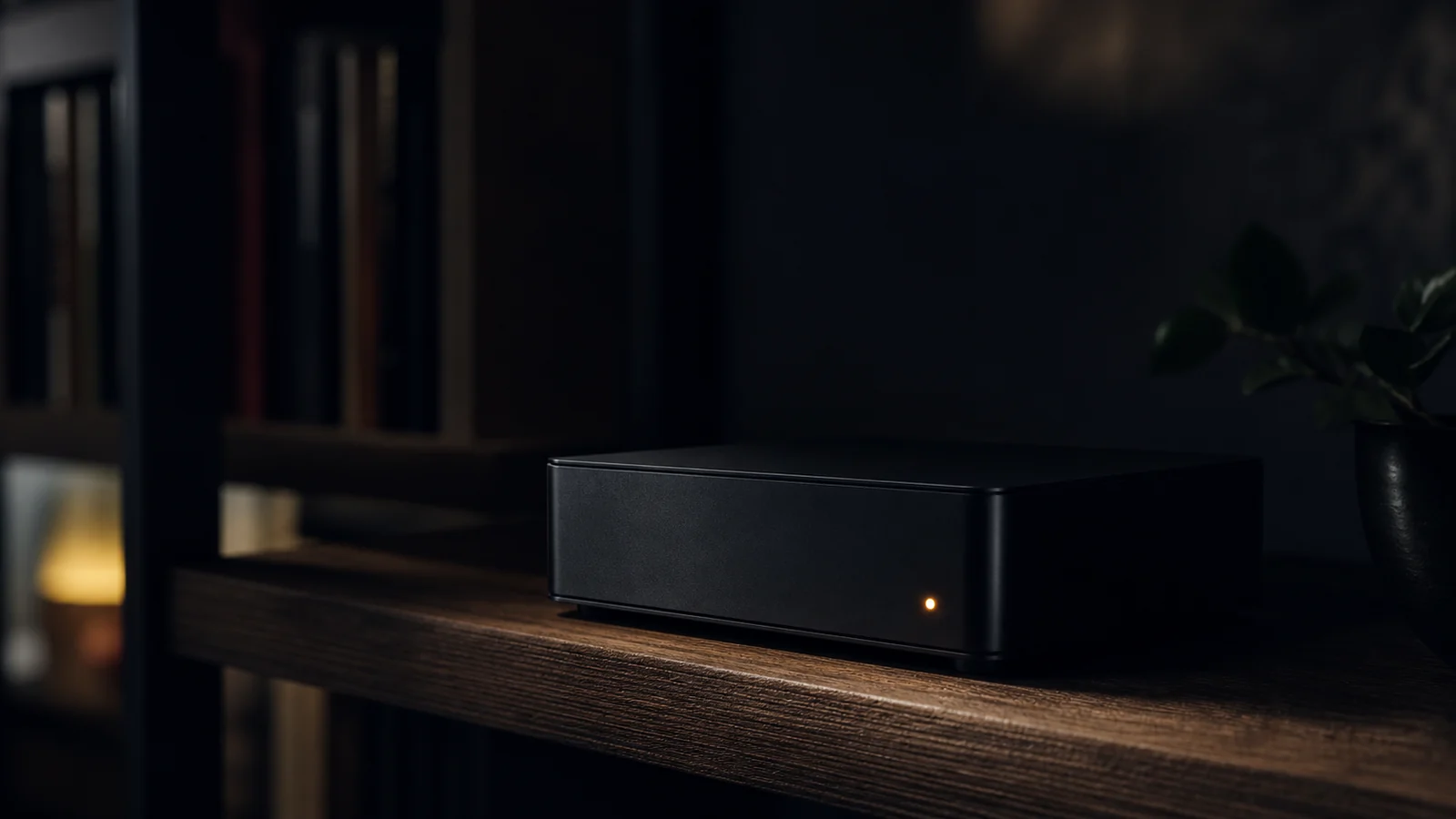
Building a quiet homelab server in 2025: the parts list and the silence trade-offs
Quiet homelab is now achievable without spending FAANG-money. The hardware is here, the trade-offs are tractable. Here is the working parts list and the noise-vs-capability math.
A 2025 homelab can be effectively silent. Not “tolerably quiet for a server room you don’t live in,” genuinely silent — sub-20 dBA at one metre, comfortable to share a bedroom with. The hardware is here, the parts are affordable, and the noise-vs-capability trade-offs are tractable.
This guide is from building three generations of quiet homelab servers since 2022, plus a current setup I’ve been running through 2024–2025. Skip the marketing benchmarks; this is the working parts list.
The three quiet-tier architectures
In 2025 you have three real choices for a quiet homelab, in increasing order of capability:
- Mini PC + external storage — single low-power node, drives in an enclosure
- Fanless / passively-cooled SFF build — purpose-built quiet small-form-factor PC
- Rack-mount with quiet fans + sound dampening — actual server hardware in a quiet rack
The first two cover ~80% of homelab needs in 2025. The third only makes sense if you’re running serious workloads (multi-VM, GPU compute, 24+ drive bays).
Tier 1: Mini PC + external storage (the dominant pick)
The single biggest shift in 2025 homelabbing is the maturation of mini PCs as homelab boxes. The Beelink / Minisforum / Aoostar lineups offer N100 / N200 / N305 / Ryzen 6-core CPUs in fanless or near-fanless chassis for $300–600.
Why this is the default now:
- 8–32GB RAM is enough for 5–15 services
- M.2 SSD storage handles OS + apps
- USB-C or Thunderbolt to an external NAS / DAS handles bulk storage
- Idle power: 5–15W
- Idle noise: 0–18 dBA (most are fanless or near-fanless)
The working build:
Mini-PC quiet homelab — May 2025 picks
- Mini PC
- Beelink S12 Pro (N100, $250) or Minisforum UM790 Pro (Ryzen 9, $700)
- RAM
- 32GB DDR5 SODIMM ($75) — almost always worth maxing the slot
- M.2 NVMe
- 1TB Crucial P3 Plus or WD SN770 ($60) for OS + apps
- External storage
- TerraMaster D5-300C 5-bay USB-C DAS ($300) + 4× 18TB enterprise HDDs (used, $150 each)
- Total spend
- ~$1,200 — covers 60-72TB raw usable storage
- Idle power
- ~10–15W base + 4-8W per spinning disk = 25-40W full system
- Idle noise
- Mini PC is silent; DAS has slow-spinning fan = ~22 dBA at 1m
What this builds covers: Proxmox or TrueNAS Scale, 10-15 self-hosted services (Plex, Immich, AdGuard, Tailscale, Home Assistant, Vaultwarden, etc.), a Postgres or two, a homelab Docker / LXC stack.
What this build doesn’t cover: transcoding 4K HDR video for many concurrent streams (CPU bottleneck), running a 70B local LLM (no GPU), serious AI workloads.
Tier 2: Fanless / passive SFF build
For users who want zero moving parts (or as close as possible), a passively-cooled small-form-factor build is the answer. This is where you spend a bit more for genuine silence rather than near-silence.
Why pick this:
- Genuinely 0 dBA — no fans, only the slow whisper of HDD platters if spinning
- More CPU horsepower than mini PCs (full-size desktop CPUs available)
- More expansion (full-size NVMe slots, multiple SATA, sometimes a PCIe x4 slot)
- Better long-term reliability — no fans means no fan failures
The working build:
Passive SFF homelab — May 2025 picks
- Case + cooler
- Streacom DA2 V2 or Akasa Maxwell Pro fanless case ($300–500)
- Motherboard
- AsRock Industrial Mini-ITX or any ITX board with TDP <65W support
- CPU
- Intel i3-12100T (35W TDP, $130) or Ryzen 5 7600 (65W, $190)
- RAM
- 32-64GB DDR5 ECC if board supports
- Storage
- 2× 2TB NVMe (mirror), 4× SATA SSD for bulk if you want zero-spinning-disk
- Total spend
- ~$1,500-2,200 depending on storage tier
- Idle power
- ~15-25W
- Idle noise
- 0 dBA — completely silent
The trade-off: SSD-only bulk storage is expensive per TB. If you want >10TB usable, you either accept spinning drives (no longer 0 dBA), pay a lot for SSD-only, or pair the silent box with a noisier DAS in another room.
Tier 3: Quiet rack-mount (when you’ve outgrown SFF)
Genuine rack servers tend to sound like jet engines because they’re designed for data centres. But a quiet rack-mount setup is achievable with:
- A rack-mount chassis with replaceable fans (Noctua, Be Quiet!)
- Sound-dampened rack cabinet (Lack-rack with foam, or proper StarTech sound rack)
- HBA cards instead of hardware RAID (less heat, less fan demand)
- Storage in a separate cabinet from compute
This tier is for people who need >24 drive bays, multiple GPUs, or genuinely large RAM. Most homelabbers don’t need it.
What the most-watched YouTube builds actually show
The single most-watched 2025 quiet homelab build is Wolfgang’s “The Perfect Home Server 2025 — 56TB, ECC, IPMI, Quiet & (kind of) Compact” (24 min, 960K views, December 2024). His parts list is the high-end version of what this guide recommends and worth quoting because the specific components he picked have been the recurring answer on r/homelab build-help threads ever since:
- CPU: AMD Ryzen 5 Pro 4650G (Zen 2, 6 cores, integrated graphics with hardware transcoding, ECC support, 19-140 € on eBay/AliExpress). The Zen 2 generation is “the first generation where AMD fixed the crashing-at-idle bug which plagued the Zen 1 and Zen plus chips.” That bug-fix history is the reason the build avoids anything older than 4th-gen G-series.
- Motherboard: Gigabyte MC12LE0 — a B550 micro-ATX server board with 6 SATA ports, 2 PCIe 4.0 slots, and an integrated BMC for remote management via web KVM. ~59 € on eBay. The pricing felt suspicious when he bought it; it has stayed that way.
- Total budget: under $500 for a build that hits ECC, IPMI, integrated graphics with hardware transcoding, quiet operation, and reasonable upgrade headroom.
The lesson the video lands on, and that this guide endorses: there is no longer a meaningful capability gap between “real server hardware” and “thoughtful consumer hardware” for homelab use. The AM4 platform plus a server-grade B550 board gets you everything a Dell PowerEdge gets you, at a tenth of the noise and a fifth of the power draw.
The counter-case worth knowing about is Techno Tim’s “I Rebuilt My Home Server — Quieter, Faster, and Ready for 2025” (12 min, 234K views, April 2025). He goes the opposite direction — Xeon Platinum 8158 (12 cores, 24 threads, 3 GHz base, gifted by Patrick from ServeTheHome), Noctua fans throughout, Seasonic Prime TX-1600 Titanium PSU with a Noctua-branded edition. His specific tradeoffs are educational: titanium-efficiency PSU + Noctua fans + careful cable management can make even a rack-mount enterprise build live in an office. Cost-prohibitive for most users (the PSU alone is $400+) but the principle is right — quietness is achievable at any tier if you select for it explicitly.
Raid Owl’s “The BEST home lab server…for me” (10 min, 137K views, November 2024) is the practitioner take that lands closer to most viewers’ actual budgets and matches this guide’s recommendations more closely — single mini-PC-class box, sensible drives, focus on what services you actually run rather than spec maximisation.
What r/homelab is actually saying
The 2024–2025 homelab community has visibly shifted toward smaller, quieter builds. Trends in the threads:
- Stealth NAS in an old Apple router — extreme aesthetic-driven quiet builds are surfacing on r/homelab front pages
- Small homelab tour threads consistently show single mini PC + DAS setups, not racks
- “My sound-proof homelab built from (mostly) second-hand enterprise gear” (972 ups, June 2025) — the high-end version, where the OP found a Japanese Si R&D sound-proof rack for $450 second-hand and is “comfortable to work next it, probably even sleep if I wanted to”
- Home power monitor threads reflect the shift — homelabbers are measuring and minimising idle power, which strongly correlates with quietness
The pattern: 2020-era homelabs were “I have a half rack in the basement.” 2025-era homelabs are “I have a $400 mini PC under my desk doing everything that half rack did, drawing 20W.”
The dB and watt budget I actually shoot for
Targets for a “live with it in the same room” build:
| Metric | Target |
|---|---|
| Idle noise at 1m | <22 dBA |
| Loud-event noise (drive spin-up, fan spool) | <30 dBA, infrequent |
| Idle power | <30W full system |
| Peak power | <120W under load |
| Acoustic profile | Steady, low-frequency only — no high-pitched whine |
You hit these with a mini PC + external storage in 2025. Five years ago this would have required a deliberate engineering project.
What to skip
The build I would not do today
Pros
- A used Dell PowerEdge / HP ProLiant from eBay — loud, power-hungry, gives more capability than most need
- Hardware RAID controllers — extra heat, extra fans, ZFS does it better in software
- 10GbE+ networking unless you have a specific bandwidth need — extra heat
- Multiple spinning drives in a 24/7 always-on configuration — power draw and noise both spike
- A "future-proof" CPU 4x larger than you need today — wasted heat / noise / power
- Building a server "to learn server hardware" if your actual goal is to run services
Cons
- Skip mini PCs if you need GPU passthrough for AI workloads — most have no GPU
- Skip fanless if your software stack does heavy bursts (compile, encode) — thermal throttling
- Skip USB-C DAS for ZFS pools you care deeply about — direct SATA connections are more reliable
- Skip consumer SMR drives — TrueNAS / ZFS hate them
- Skip used drives from sketchy resellers — used enterprise from reputable resellers (ServerPartDeals, GoHardDrive) is fine
- Skip "audiophile-grade silent" components for marginal dB improvements when a layout choice gets more
The recommendation
For a 2025 quiet homelab build with zero existing hardware:
- Beelink S12 Pro mini PC ($250) + 32GB RAM ($75) + 1TB NVMe ($60) = ~$400 for the compute brain
- TerraMaster D5-300C DAS ($300) + 4× used 18TB enterprise HDDs ($600 total) = ~$900 for 60TB+ storage
- TrueNAS Scale on the mini PC, exporting the DAS as a ZFS pool
- Tailscale for remote access, Proxmox if you prefer VM/LXC over the TrueNAS app store
Total: ~$1,300 for a homelab that idles at 15-25W, sounds like a quiet refrigerator, and does 90% of what a half-rack did five years ago.
For the storage architecture, see our ZFS pool design guide. For the OS choice, TrueNAS Scale vs Core. For the hypervisor option, Proxmox VE review.
Sources
Every reference behind this piece. If we make a claim, it's because at least one of these said so — or we lived it ourselves.
- Firsthand Built and operated three generations of quiet homelab servers since 2022
- Blog r/homelab — stealth NAS inside an old Apple router — r/homelab
- Blog r/homelab — small / quiet homelab tour thread — r/homelab
- Blog r/homelab — installed a home power monitor — r/homelab
- YouTube The Perfect Home Server 2025 – 56TB, ECC, IPMI, Quiet & (kind of) Compact — Wolfgang's Channel
- YouTube I Rebuilt My Home Server — Quieter, Faster, and Ready for 2025 — Techno Tim
- YouTube The BEST home lab server...for me — Raid Owl